Continuum · one room, the whole relationship
The room your customer keeps after they sign.
Most tools stop at the signature. The customer signs, a new person picks them up, and they explain everything again. Continuum is one room your customer already knows: the plan, the answers, the documents and the people, from the first conversation through onboarding, renewal and expansion. One link, no login, and it still works in year three.
A fictional customer, two weeks into onboarding. No login, nothing recorded. Tick a step, ask a question, forward it to a colleague.
No second explanation
Move deals faster
See risk and expansion earlier
No second explanation
Move deals faster
See risk and expansion earlier
56%
Qualified
4
Open steps
9×
Room opened
Questions from the room
Business case
Peak-season resilience · ready to forward
What we agreed
Ask the team · no new email
The same relationship, from both sides. Add a step and they see it; they tick one off and you see that; they ask a question in the room and you answer it there, with no new email thread. It works the same way in month one and in year three.
The revenue problem
Fragmented customer relationships cost you revenue.
Not an operational inconvenience. A chain with a price on the end of it: the relationship fragments, context goes missing at every seam, signals nobody was watching for get lost, and what arrives is a stalled deal, a handover that starts from nothing, and a renewal conversation nobody saw coming.
Without Continuum
The relationship is handed down a chain. Every system keeps a piece and none of them keeps the customer.
- Salesowns it
- CRMrecords it
- Emailhalf of it lives here
- Meetingsrecorded, rarely rewatched
- Onboardingstarts again
- CS platforma different picture
- Supporttickets, no context
- Renewalwho knew them?
With Continuum
One relationship, one room, one link. The systems stay exactly where they are and feed it.
Meridian Retail · one continuous relationship
- Sales
- Onboarding
- Adoption
- Renewal
- Expansion
continuum.app/r/meridian · the same link at every stage
“We need a better way for our customers and our teams to work together, and we want to understand what’s actually happening in those relationships.”
The sentence we keep hearing, from revenue leaders who already own every tool on the left.
Where it shows up
You will recognise most of this.
Sales
- Good opportunities lose momentum between meetings
- Next steps live in an email thread nobody owns
- The buying committee is impossible to coordinate
- Context from the last conversation goes missing in the next
Onboarding
- The team inherits a summary, not the relationship
- The customer explains their own business a second time
- Promises made in the deal are scattered across recordings
- Week one is spent reconstructing what sales already knew
Customer success
- No one holds the full history of the relationship
- Engagement is hard to read until it has already gone
- Risk surfaces at the renewal, which is far too late
- Expansion signals sit in a usage report nobody opens
One problem underneath all twelve. The relationship exists across too many disconnected systems. Your CRM records it. Email holds pieces of it. Meetings hold more. Your success platform holds a different picture again. There is no shared place where the relationship itself continuously happens.
The idea
One customer. One relationship. One shared room.
The relationship does not reset when the deal closes, when onboarding takes over, when success inherits it, or when the renewal comes round. The room changes shape and the name on it changes once, from the team who won it to the team who keeps it. The customer never notices a change at all.
Sales
Win it
New business
Onboarding
Get them live
Account management
Adoption
Prove the value
Account management
Renewal
Keep it
Account management
Expansion
Grow it
Account management
The calls, the documents, the business case and the people are still there on day one of onboarding, because it is the same room rather than a handover document. Same room, same link, same history, in month one and in year three.
Alongside your stack
Keep the tools you already run. Give the relationship a place to live.
Your CRM stays the system of record. Your service desk stays your service desk. Your training platform, your usage analytics, your meetings and your documents all stay exactly where they are. Each of them manages a piece of the relationship, and Continuum’s job is to take one fact from each and put it where both sides can see it, rather than ask anyone to re-type a number a system already knows. The diagram says which of those links run today and which are still an adapter we owe you.
Continuum
One relationship, assembled from all of it
Usage analytics
Planhat · Gainsight
seats in use, against what they bought
Training platform
HowNow · Docebo
who on their side finished onboarding
Service desk
Zendesk · Jira
how many open, how old, what is breaching
CRM
Salesforce · HubSpot · Pipedrive
the record of account, stage and owner
Your own knowledge
MCP servers
products, pricing and references the AI can cite
Calendar & email
Outlook · Microsoft 365
the meetings, and any email Bcc'd to the deal
Chat
Slack · Teams
the alert, in the channel the deal team lives in
Call recordings
Gong · Zoom
what the customer actually said, still watchable
Meridian Health · one line, on one screen, and in their own room
Renews in 38 days · 4 open tickets, 1 breaching · 47 people on 40 seats · hitting their savings target · champion quiet for 47 days
Every clause belongs to a different system. None of them can write the sentence.
Courses belong in the course platform
We have no business hosting one. What HowNow cannot tell you is which named people on this customer’s side have started and which have not, so that is the one fact we would take from it, and their own room is where that team’s progress would show. Planned: the spoke is on the diagram, the adapter is not written.
Tickets belong in the service desk
A customer who can reply to a ticket in two places has two threads and a support team who resents you. So Continuum would carry the shape (how many, how old, what is breaching) next to the renewal date, and every row would link out to Zendesk to be answered there. Planned, for the same reason as the rest of the top row.
The AI reads your systems, not the internet
Connect your own MCP servers once: a product catalogue, a pricing sheet, a knowledge base. The model reads them while it drafts. A business case cites what you actually sell at your actual prices, instead of inventing something plausible. Connected today — of the three on this row, it is the one you can use now.
The loop
Your systems fill the room. The room fills them back.
The value is not that Continuum sits next to your stack. It is that a customer taking part produces something your own systems could not have generated on their own. Four of the six steps run today. The two that reach into other companies’ software are the two ends, and they are mapped and waiting on their adapters — which the cards below label one by one rather than leaving you to assume.
Your systems give context
The account, the owner, the stage, the contract. Typed once, where it already lives.
The relationship gets a room
One workspace per customer, open to both sides, from the first call onward.
Your customer takes part
They add steps, upload documents, ask questions, forward the room to their own people.
Taking part becomes signal
Who came back, who went quiet, what got opened twice, who you have never met.
Signal reaches whoever owns it
The rep, the account manager, and any AI you point at the room.
And flows back to your systems
Engagement, plan completion, days in onboarding: written back, never re-keyed.
Six back to one: what your customer does in the room becomes something your own systems know. The two ends that touch other companies’ software are mapped and waiting on their adapters, and the page says so rather than drawing a finished circle.
What gets better
Three things change, and they all carry a number.
Continuity is not the point on its own. These are the reasons it is worth paying for.
No second explanation
The customer signs and keeps the same room: the plan, the answers, the documents and the people. Onboarding starts from what was agreed, not from a blank page.
Move deals faster
Keep the buying group engaged, keep the next step visible to both sides, and stop losing a fortnight to a question nobody asked out loud.
See risk and expansion earlier
A champion who stopped showing up, a team over its seat count: both are visible while there is still time to do something about them.
For your team
Structure, not a blank page
Every deal and every account runs the same way: the qualification, the plan, the stakeholders, the next step.
Signal, because they took part
Who opened what, who went quiet, what they read twice, and who they forwarded the room to that you have never met.
Where to spend Monday
Your whole book ranked by who needs you first: a deal heating up, a champion gone silent, a customer over capacity.
For your customer
Somewhere to work, not to read
They add steps, upload their questionnaire, ask questions and write their own case to their board. Not a folder with a logo on it.
No account, no install
One link, and it still works two years later.
An experience they notice
Most vendors send attachments. You give them a room.
The difference
Your CRM records the relationship. Continuum is where it happens.
This is not an argument about who holds more data. Modern systems capture an enormous amount, and they get better at it every year. It is an argument about who is holding the pen.
- YouAdd: security review callstep added
- MeridianReturn signed NDAticked by Alex
- MeridianAdd: legal sign-off, our sidestep they added
- Meridianvendor-questionnaire.pdfthey uploaded it
- BothBusiness case: 5 days to 2written together
- Meridian“Can we get the security whitepaper?”asked in the room
Not your record of what they said. The thing itself, with their hands on it too.
A shared workspace that keeps evolving, wired into the systems you already run. Your customer takes part in it, your teams take part in it, AI reads what is happening in it, and it does not stop at the signature.
Every other system has one author
Your company writes all of it, including the parts about your customer. A perfect transcript of both sides agreeing a plan is still your record of an agreement, written by you.
This one has two
The plan is not a record of what you agreed. It is the agreement, and your customer edits it. So do the documents, the questions, the intake, and the answer to the security review.
Which is why it holds up
Better models will keep improving what your systems can extract from your own side. None of that turns a record into a place your customer is actually in.
Who it's for
Two teams and a customer, in one room.
The rep chasing the signature, the account manager who owns it for the next three years, and the customer living with the decision. Pick one.
For the rep chasing a signature
Know where the deal really stands, and arm the person selling for you.
Your champion does the selling when you're not in the room. Continuum gives them something to forward, and gives you the signals to know whether it landed.
- Qualification and next best action on every deal, in one view
- See what the buyer opened, and when they went quiet
- A business case framed for their boss, not for your CRM
Daniel Okoye
Champion
Identified
Economic buyer
Needs you today
Overdue: prepare pricing proposal v2
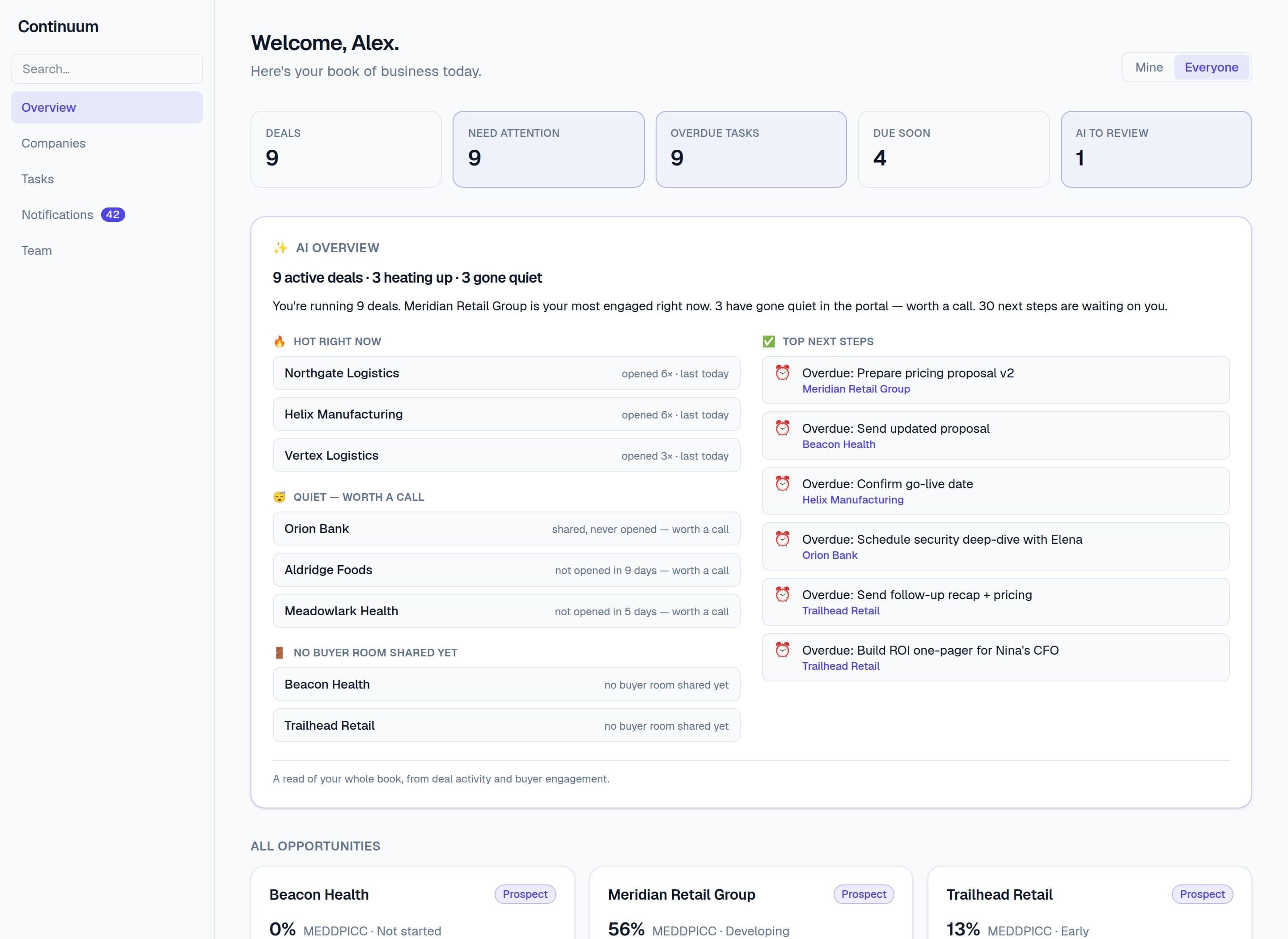
What you open on a Monday: every deal you are running, read by AI overnight, and a brief that says which accounts need you first and why. Heating up, gone quiet, no room shared yet.
How it works
Three moves, and the deal runs itself.
Run the relationship from one place
The deal, then the onboarding, then the renewal. One view, instead of a CRM, a drive, three inboxes and a success tool that never met the seller.
- Qualification, stakeholders, meetings, notes and the plan, together
- The one thing this account needs first, and everything else still open
- AI reads each call and proposes updates, and you approve them
Give them a room, not an inbox
A branded space holding the business case, documents and recordings. One link they can forward to their boss while deciding, and still open two years later.
- No account to create and nothing to install
- They ask questions, grab documents and share files themselves
- One continuous thread from first call through renewal
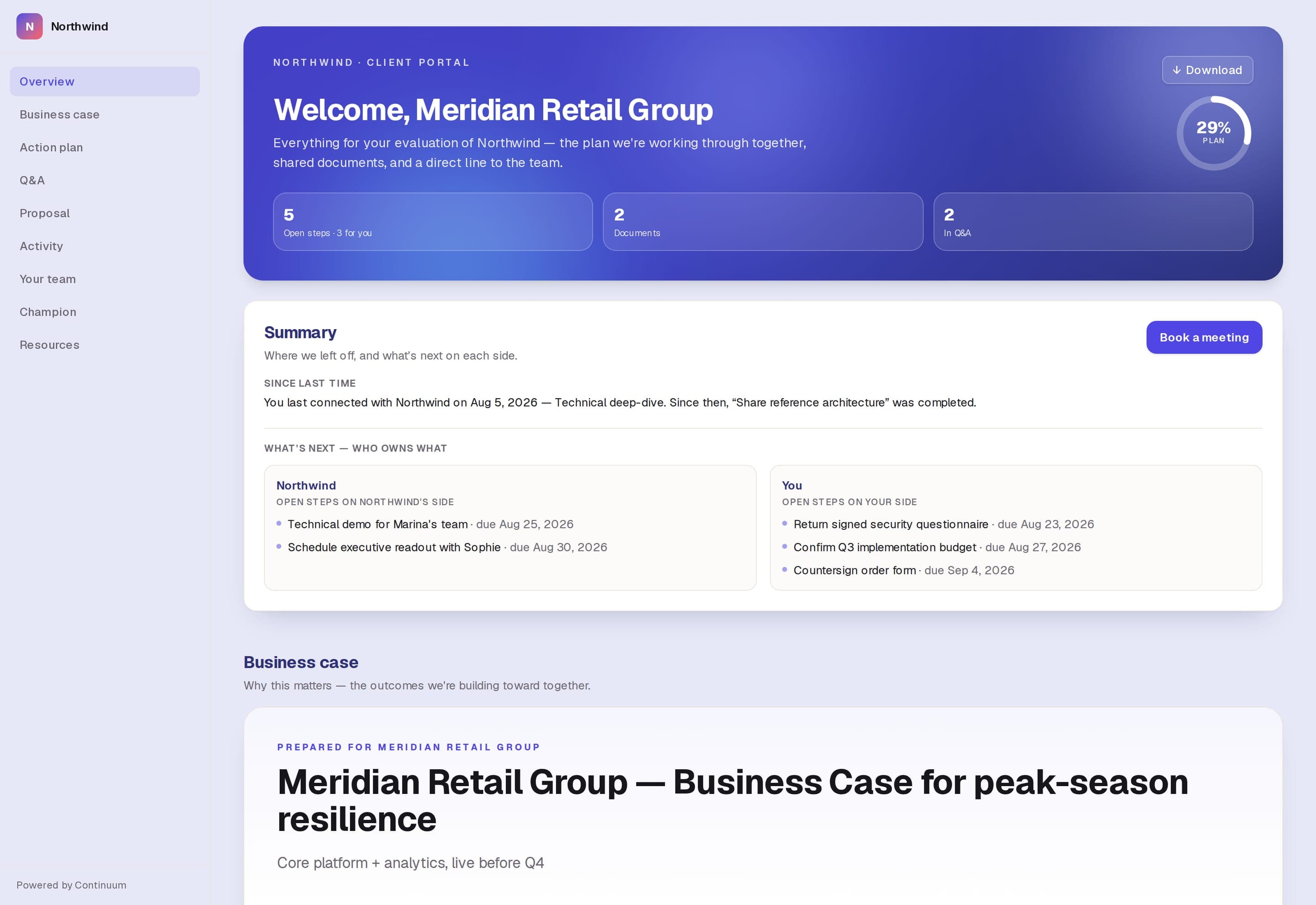
Agree a plan you both own
Every next step with an owner on each side and a date. Either side can add a step or tick one off, so it stays a plan, not a microsite your buyer reads once.
- Steps owned by you or by them, never ambiguous
- Your champion gets a business case built to forward internally
- You see what they engage with, so silence becomes visible
For your customer
A room your customer works in, not one they read.
Every customer portal you have been offered before asked your buyer to create an account, and that is where most of their colleagues stopped. This one is a link. Nothing to join, nothing to remember, and they can forward it to someone you have never met.
Which is why they use it rather than file it. They add steps to the plan, upload their own questionnaire, ask a question and get it answered in the room, and pull the recording of the call their colleague missed. On your branding, and the same link still opens in year three.
Northwind × Meridian Retail
Shared workspace for Meridian Retail Group
Welcome — everything for our work together lives here. Ask a question or add a file any time.
60%
Plan complete
2
Steps for you
9
Documents
Mutual action plan
The steps to move forward — either side can add a step or tick one off.
Questions
Ask the team anything — pricing, security, timelines. They'll reply here.
Your team
The people from Northwind working with you — reach out any time.
Champion this internally
Build the case with your team and bring the right people into the conversation.
Share with a colleague
Loop someone in — they’ll get a link to this workspace by email.
Resources
Everything for our work together in one place — materials from Northwind, recordings, and the files you share.
Platform Overview Demo
How the platform works, in four minutes.
Case Studies
Meeting Recordings
Catch up on conversations, or share them with your team.
About Northwind
Security, legal and company documents.
Shared Files & Documents
From Northwind
Shared by you
🎓 Training
Courses to get your team confident on the product.
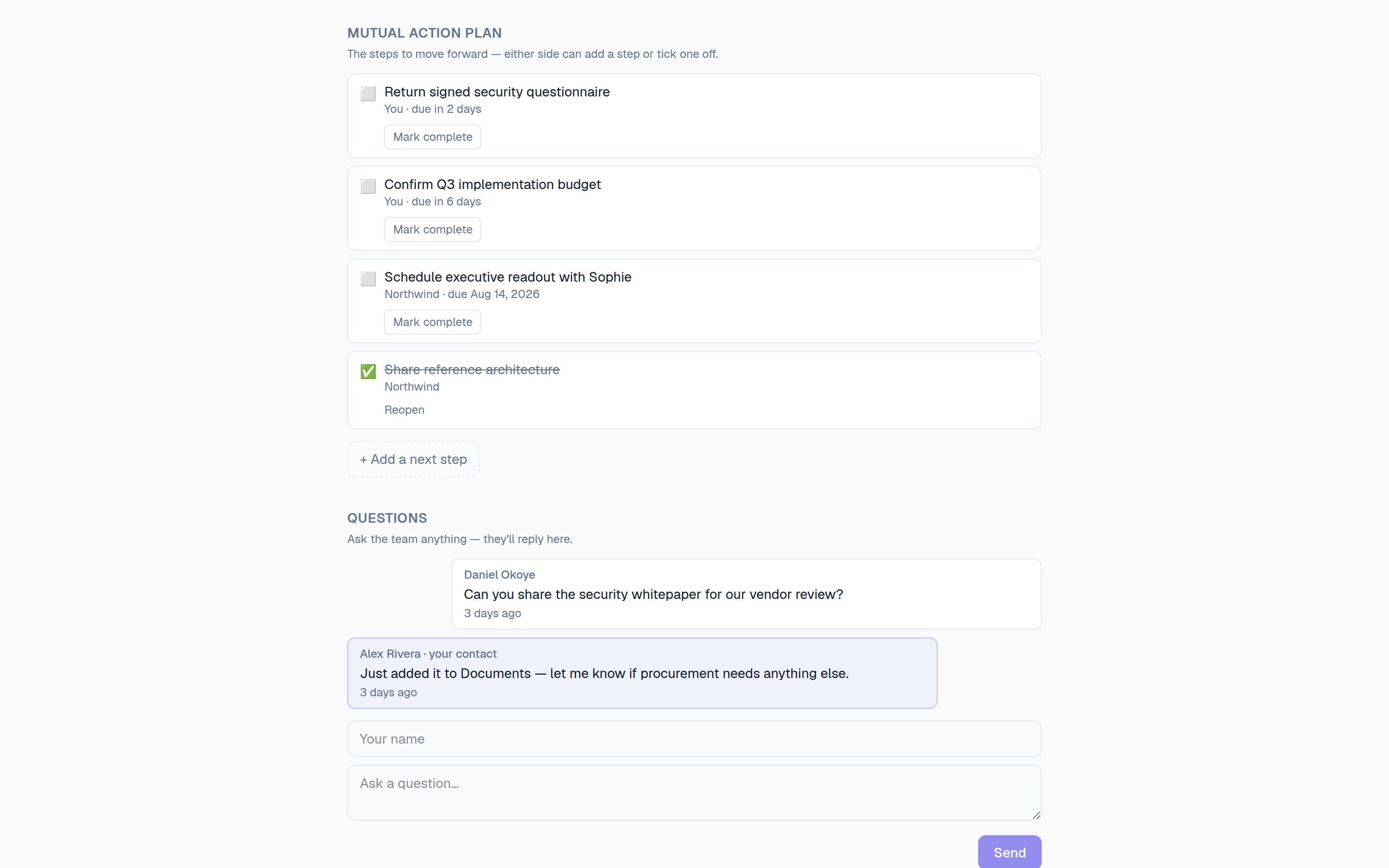
One room, on your branding: the plan, the conversation, the people they can call, and a Resources shelf holding your demo, your case studies, the call recordings, your security and legal documents, training, and files going both ways. They see only what you mark customer-visible.
And they write in it
Your champion makes their own case, in your room.
Somewhere in every deal, one person has to sell you to their own colleagues in a meeting you are not invited to. They can write that pitch here, in their words, above everything you gave them to back it up.
“Team, this is the one. Month-end close goes from five days to two, the security review is already done, and I’ve put their answers to Priya’s questions in here. Read the business case before Thursday.”
There is no field in any CRM for this, because it is not your sentence and it is not aimed at you. It is the clearest proof that the room belongs to the relationship rather than to the vendor.
You will not have to guess whether it worked.
The honest question about any customer portal is whether the customer will use it, and most of them never answer it. The same room that runs the relationship reports on itself: who opened it, who came back, who has not been in for a fortnight, and which colleague it reached that you have never spoken to. You will know inside the first week, on your first real deal — and you can stop reading this page and go and find out.
Where to act
Twelve deals. One list, in the order that matters.
Signal is only useful if it tells you what to do on a Monday. Continuum scores every deal on what's overdue, what the AI has proposed, what your buyer asked and how long they've been quiet, and hands you the queue, highest first.
No hidden score out of a hundred. Every state on this page is two numbers and a role, so anybody can say out loud why an account is on the list, including to the person it is about.
Ask your book
“Where should I focus this week?”
The order isn't typed in once. It's recomputed from the deal's own state every time you open it.
What it watches
Steps past due and due this week, AI suggestions waiting on your approval, questions your buyer asked, qualification still missing, and rooms that have gone quiet.
How it reaches you
A daily email of what's past due and due this week, and a weekly note on what each buyer actually did, so a deal going cold reaches you before the forecast call does.
When you'd rather just ask
“Which deals need attention today?”, “What's gone quiet?”, “Where should I focus this week?”, answered from your own deal data, not a generic model.
For account management
A book ranked by who needs you first.
A seller’s list is ordered by what is closest to closing. Yours has to be ordered by what needs you first, and the account quietly heading for churn and the one that outgrew its contract two months ago are both urgent, and neither of them sends you an email about it.
19 of 50 seats · paying for 31 nobody uses
47 of 40 seats · 7 over, three months running
16 of 25 seats · 3 named users never signed in
23 of 25 seats · steady since go-live
Needs you this week
Renewal in 38 days and the champion has not replied since the QBR
Value delivered
340 hrs saved
against the 300 they were sold
Adoption
6 of 9 trained
3 named users never started
Support, from your service desk
opens in Zendesk →4 open · oldest 9 days · 1 breaching
the shape only. Nothing is answered here
Expansion signal · Northgate Retail
renews in 4 months47 people using 40 seats, three months running
worth raising now, not in the renewal negotiation
What they were promised, 14 months ago
“Cut month-end close from 5 days to 2”, from the business case the seller wrote with them
Usage cuts both ways
Half the seats unused six weeks before a renewal is a churn risk. Forty seats carrying forty-seven people is an expansion conversation you should be having now, not discovering in the negotiation. Same number, opposite meaning, and only the relationship around it tells you which.
Quiet is a signal, not an absence
A champion who has stopped opening the room is the single best predictor of a renewal going badly, and it is the one thing no dashboard reports, because nothing happened.
You inherit the business case, not a summary
What they were promised is on the screen fourteen months later, in the words the customer used, so the renewal is a conversation about a number you both already agreed.
The handover
The moment most relationships quietly restart.
A deal is won by one team and delivered by another. In most stacks that is a forwarded email and a kickoff call spent repeating what the customer already said.
New business
Meridian Health · Opportunity
What carries over
Account management
Meridian Health · Onboarding
What changes
The seller leaves the deal, not a summary of it
The calls, the documents, the people and the business case are already there. Nobody writes a handover doc that goes stale in a fortnight.
The account manager reads the room first
Before the kickoff, not after it. Everything the customer told the seller is on one screen, so they never have to say it twice.
The customer keeps their link
Same room, same bookmark. It stops being a pitch and starts being progress, and nobody sends them a new URL.
When the buyer becomes a customer
The room they already have becomes the room they keep.
No migration, no new login, no email explaining that the tool has changed. The bookmark they saved during the evaluation is the one they open in year three.
Business case
Cut month-end close from 5 days to 2
written with them, not at them
Mutual action plan
Security review → Pricing → Signature
Shared with
Champion, economic buyer, IT
continuum.app/r/meridian-health
Value, against the promise
340 hrs saved · target 300
synced from your usage tool
Where we are
Onboarding ✓ · Live · Renewal in 74 days
the same plan, further along
Open with your team
2 requests · 1 answered today
mirrored from your service desk
Their team's progress
6 of 9 finished training
deep-links into your LMS
continuum.app/r/meridian-health
unchanged since the first call
This is the part most stacks lose. The pre-sale room was a microsite that got switched off at signature, and the customer starts again somewhere else, with a different link, a different login, and nobody who remembers what they were promised.
And your AI
Every AI you buy this year points at your own side.
Summarise my calls. Update my CRM. Tell me which deal to work. All of it useful, all of it aimed inward, and none of it reaches the person deciding whether to buy. The better your internal AI gets, the odder it looks that your customer cannot see any of it.
Context, not another assistant
An agent reading your systems knows what reached your side. It does not know what both sides agreed, who has been back this week, or which step your customer added on Tuesday. That is what this room holds.
It proposes, a person approves
Nothing the model drafts reaches a customer unapproved: the qualification, the next steps, the follow-up all wait for a human, and every suggestion cites where it came from.
Your customer gets an answer too
A question asked in the room at eleven on a Sunday can be answered from your own product catalogue and pricing, because you connected those systems. Not from the open internet.
We are not going to out-summarise the companies whose whole business is summarising. The part nobody else can hand a model is the state of a relationship two people are actually in.
Built for Europe
Built to be trusted with the deal.
Deal data, yours and your buyer's, deserves to be handled properly. Especially in Europe.
EU data residency
Hosted in the EU by default. Your buyers' data stays in the EU.
GDPR-native, not bolted on
The buyer portal asks before it measures anything. Full export and permanent deletion are built in, and every privacy-relevant action is recorded.
AI proposes, a human approves
Nothing the AI suggests reaches your data until someone accepts it, enforced in the software, not promised in a policy. AI you can put in front of a regulated buyer.
Getting started
Your first room takes about a minute.
No implementation project, no data migration, and nothing for your buyer to install.
Add the company
A name is enough. The workspace, the timeline and the plan are created with it.
Share one link
Your buyer opens it and they're in. No account, no password, no software to install.
Works in any browser, on any device.
Run it together
Both sides work in the same room. After each call, AI proposes the updates, and you approve them.
AI suggests
Move “Security review” to 12 Sept
See it in action
Watch one customer go from sales to renewal in a single room.
Twenty minutes, on a relationship you are running now. You will see the deal open, the customer join, the handover happen without anything being rebuilt, and the moment Continuum flags an account going quiet. Then decide whether the problem is worth solving. If you would rather look first, the example room is open now.
Continuum is opening to a small group of revenue teams. Tell us a little about what you sell and we'll be in touch.